
If you own or manage property in Santee and you just received a notice about backflow testing, it can be hard to tell what is truly urgent and what feels like more red tape. The letter mentions deadlines, regulations, and certified testers, but it probably does not explain what happens if you wait or what exactly you are supposed to do. That uncertainty makes it easy to put the notice on the pile and hope it can wait.
Backflow regulations in Santee are not just paperwork. They are how local water providers protect the drinking water that you, your tenants, and your customers use every day. Those regulations come with real requirements and, if they are ignored long enough, real consequences like shutoff and fees. Once you understand how the rules actually work in practice, staying compliant becomes a straightforward routine instead of a mystery.
At Backflow Services, our team has been based in Santee since 2004 and focuses only on backflow prevention assemblies across San Diego and Imperial Counties. General plumbing contractors regularly bring us in when a project or property has backflow requirements they do not want to guess at. In this guide, we share how local backflow regulations apply to Santee properties, what happens if you fall behind, and how we help owners stay ahead of testing and paperwork year after year.
Why Santee Has Strict Backflow Regulations
Every time you turn on a tap in Santee, you are using water that has been treated, pressurized, and distributed through a shared public water system. Backflow occurs when water reverses direction and flows from a private plumbing system back into that public supply. If that private system is connected to irrigation lines, chemicals, industrial equipment, or other non-potable sources, contaminants can enter the drinking water system during a backflow event.
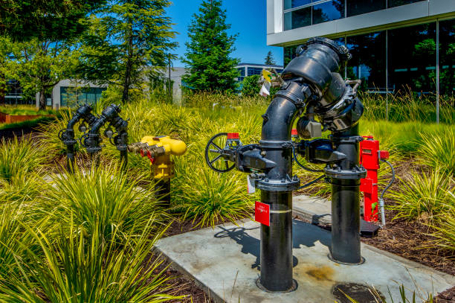
Backflow prevention assemblies are designed to stop that from happening. These mechanical devices use internal valves and springs to allow water to flow in only one direction. If pressure changes cause water to move backward, the assembly automatically closes to block the reverse flow.
These devices are commonly installed anywhere a cross-connection exists, including:
- Irrigation systems
- Fire sprinkler systems
- Commercial equipment
- Industrial processes
- Multi-use plumbing systems
- Any connection between potable and non-potable water sources
Santee-area water providers are required to follow strict cross-connection control standards to help protect the public water supply. That is why property owners receive notices requiring testing, certification, and compliance documentation. These regulations are not arbitrary policies created by individual inspectors. They are part of a broader public health program designed to prevent contamination from affecting neighboring properties and the community as a whole.
Because we have specialized in backflow prevention for decades, we see how these regulations are applied across homes, commercial properties, and institutions throughout the Santee area every day. Our experience working directly with local water providers allows us to explain requirements clearly, help property owners stay compliant, and simplify a process that often feels confusing or overly technical.
Which Santee Properties Must Have Backflow Protection
Many Santee property owners are not sure whether backflow regulations even apply to them. They may assume that only very large or industrial sites need devices, or they may think backflow assemblies are something the city installs and maintains on its own. In practice, a wide range of properties in and around Santee are required to have backflow protection, and responsibility usually rests with the property owner or manager.
Some of the most common triggers for required backflow assemblies include dedicated irrigation services, commercial buildings, and fire sprinkler systems. If you have a separate irrigation meter serving landscaping, that service often has a backflow prevention assembly near the meter or in a nearby vault. Commercial and mixed-use buildings typically have one or more assemblies at the property line or on specific branches of the system, particularly if there are restaurant spaces, medical suites, or equipment using water in ways that could create a cross-connection.
Medical and dental offices, facilities that use chemicals, and properties with pools or decorative fountains are frequently classified as higher risk and can face stricter device and testing requirements. Multi-tenant complexes, such as shopping centers or office parks, often have several assemblies serving different parts of the site, including irrigation, fire lines, and domestic water. Even single-family homes can have backflow protection if they have certain types of irrigation or special systems connected to their water supply.
Although the exact requirements can vary between water purveyors in the Santee area, the underlying goal is the same, which is to prevent contaminants from entering the public system. Property owners are usually responsible for owning, maintaining, and testing the devices on their side of the meter, even when those devices sit in a box that looks like it belongs to the city. At Backflow Services, we work across residential, commercial, and institutional properties, so we are familiar with how these requirements are applied on everything from private homes to hospitals and schools in our region.
How the Backflow Testing Cycle Works in Santee
Once a backflow prevention assembly is installed, local regulations typically require testing once per year. In the Santee area, the process usually begins with a notice from the water provider identifying which device needs testing and when the results must be submitted.
The notice also explains that:
- Testing must be completed by a certified tester
- Calibrated testing equipment is required
- Official test reports must be submitted on time
What the Testing Process Looks Like
For most property owners, the process is straightforward:
- Receive the testing notice
- Schedule a certified backflow tester
- Complete onsite testing
- Submit the official test report
If the assembly passes, the provider updates its records. If it fails, repairs or replacement may be required before compliance is finalized.
What Happens During a Backflow Test?
Backflow testing is more than a visual inspection. A certified tester connects a calibrated gauge to the assembly and measures how the internal components perform under controlled conditions.
The test verifies that the assembly:
- Prevents reverse water flow
- Maintains proper pressure
- Meets local compliance standards
Why Early Scheduling Helps
Many property owners wait until the end of their testing window, which can create scheduling delays. Working with a company familiar with local agencies can also help streamline reporting and compliance.
At Backflow Services, we use calibrated testing equipment and factory-trained technicians experienced with local water provider requirements throughout San Diego County and Imperial County.
What Happens If You Ignore Backflow Notices
Because backflow testing notices usually arrive by mail, some Santee property owners assume missing a deadline once or twice is not a serious issue. In reality, water providers treat untested backflow assemblies as potential public health risks, and missed deadlines can quickly lead to additional notices, fees, and possible water service interruption.
The process often follows a predictable pattern:
- Initial annual testing notice is sent
- A second or final warning may follow if no report is submitted
- Administrative penalties or late fees can be added
- Water service may eventually be interrupted for continued noncompliance
The purpose of these requirements is not punishment. Water providers are responsible for protecting the public water supply, and untested devices create uncertainty about whether contamination could flow back into the system.
Property owners and managers are ultimately responsible for maintaining compliance. If ownership changes, tenants move out, or management transitions occur, testing notices can easily be overlooked. Unfortunately, what started as a routine annual requirement can quickly become an urgent issue with short deadlines and potential business disruption.
Ignoring backflow requirements can also create broader liability concerns. If a contamination issue were ever linked to an untested assembly, compliance history would likely become part of the review process.
At Backflow Services, we regularly help residential and commercial property owners who have fallen behind on testing requirements. Our team can quickly inspect assemblies, perform needed repairs, complete certified testing, and submit the proper documentation to help restore compliance with local water provider requirements.
Repairs, Replacements, and Failed Backflow Tests
Even when you stay on schedule, not every backflow assembly will pass its test every year. These devices contain internal springs, seals, and moving parts that wear over time, especially in areas with sediment or fluctuating water conditions. A failed test does not automatically mean something was done wrong. It usually means the assembly has reached a point where maintenance or replacement is needed to keep doing its job.
Common reasons for failure include worn seals that no longer hold the required pressure, debris lodged in the valve seats, and internal parts that are no longer moving freely. Sometimes, the original installation did not fully match the manufacturer’s specifications, and that mismatch only becomes obvious when the device is tested under proper conditions. Occasionally, an assembly that was sized for the original use of the property is now serving a different or heavier demand, which can stress the device and shorten its service life.
When a device fails, the test report will reflect that status, and the water provider typically expects the problem to be corrected within a relatively short period. The next steps are to repair or replace the assembly and then perform a re-test to confirm that it now meets the required performance. Repairs can involve opening the device, replacing internal components with manufacturer-approved parts, cleaning seats and springs, and reassembling everything to the correct configuration.
Using the right parts and procedures matters. Repairs performed with non-approved components or in ways that do not match the manufacturer’s instructions can lead to repeated failures, warranty issues, and questions from regulators. Our technicians at Backflow Services receive direct training from leading backflow prevention assembly manufacturers and are authorized to perform warranty repairs. This means we understand the design and maintenance requirements of a wide variety of devices, and we can bring assemblies back into compliance in a way that aligns with both manufacturer expectations and the performance standards used by local water providers.
Cross-Connection Surveys and New Projects in Santee
Backflow regulations in Santee affect more than existing devices. When you plan a new building, remodel a commercial space, add a pool, or change how a property uses water, you may be required to complete a cross-connection survey. Many owners and contractors are surprised by this step, because it typically comes from the water purveyor rather than the building department and focuses specifically on how the plumbing system interacts with the public supply.
A cross-connection survey is a systematic review of a property’s water uses and plumbing layout to identify any point where potable water could come into contact with non-potable sources. For example, irrigation systems that use fertilizers, fire sprinkler systems with chemical additives, equipment supplied by both potable and auxiliary water sources, and decorative water features can all create potential cross-connections. The survey documents these risks and recommends where backflow prevention assemblies or other controls are required.
The findings from a survey can lead to new or upgraded backflow protection requirements. A planned tenant improvement that originally seemed straightforward might now require additional assemblies on new branches, or a change of use from retail to restaurant might increase the hazard classification for a service. If these requirements are not accounted for early, they can become costly surprises late in the project when schedules are tight and access is limited.
Because Backflow Services works closely with both plumbing contractors and property owners across San Diego County and Imperial County, we are often brought into projects to help interpret survey results and design practical solutions that satisfy the water provider. We have handled cross-connection control work for complex environments such as airports, hospitals, military installations, and educational institutions. That experience helps us guide Santee projects so that backflow protection is integrated correctly from the beginning instead of added in a rush at the end.
How We Help Santee Properties Stay Compliant Year After Year
Once you understand how backflow regulations work, it becomes clear that compliance is an ongoing task rather than a one-time project. Devices need to be tested on schedule, test dates need to be tracked, reports must be submitted in the right format, and repairs or replacements must be handled promptly when assemblies fail. For many Santee property owners and managers, the hardest part is simply keeping all of those moving pieces organized while also handling the rest of their responsibilities.
At Backflow Services, we structure our services around that ongoing need. We provide testing with calibrated equipment, complete the required documentation, and submit reports to the appropriate water providers in the formats they expect. When a device fails, we can evaluate whether repair or replacement makes more sense based on its age, condition, and availability of parts, and we can carry out the work according to manufacturer instructions so that the assembly returns to reliable service.
We also put a strong emphasis on clear communication and planning. Before any work begins, we provide free estimates so you know what to expect for testing, repairs, or replacements. During scheduling, we work with you to minimize disruption to your home or business and to avoid last-minute rushes against testing deadlines. Because general plumbing firms across the region frequently subcontract their backflow work to us, our team stays busy and current with a wide range of assemblies and site conditions, which helps keep our skills sharp and our processes efficient.
For many of our clients, the biggest benefit is peace of mind. They do not have to track test dates, worry about whether a report was filled out correctly, or spend time deciphering notices. Instead, they have a local Santee-based team that has been focused on backflow prevention since 2004 and that treats the protection of the potable water supply as a daily responsibility. That consistency helps them stay ahead of backflow regulations in Santee and avoid surprises that interrupt their operations or put their water at risk.
Talk With a Santee-Based Backflow Team About Your Compliance
Santee’s backflow regulations can feel complicated at first glance, but they follow a clear logic. Water providers want to know which properties create potential cross-connections, which assemblies are in place, and whether those assemblies are still working as designed. When you understand which category your property falls into, what is required each year, and what happens when a device fails, you can turn compliance into a predictable part of your maintenance routine instead of a last-minute scramble whenever a notice arrives.
If you are not sure whether your property has the right backflow protection, if you have received a testing notice, or if you simply want to get ahead of the next deadline, we can walk through your situation and outline practical next steps. Backflow Services offers free estimates for backflow testing, repairs, replacements, rentals, and cross-connection surveys, and we have many years of local experience helping Santee properties keep their water systems safe and compliant without unnecessary stress.
Call (619) 848-6866 to schedule a backflow compliance review for your Santee property.